Civic Toolkit

Civic Toolkit

Practical materials to promote an informed citizenry.

How to Find Public Notices in St. John the Baptist Parish

Edgard, LA

The Fleuve Civic Toolkit, Item No. 6

Transparent government depends on residents having access to information. Public notices help us track proposed ordinances, budgets, elections, zoning hearings, court proceedings, and public meetings. They let residents follow public business and, when applicable, weigh in before decisions are made.

On June 23, 2026, at its second meeting that month, the St. John the Baptist Parish Council voted to designate The Advocate as the parish's official journal of record. The governing body said L'Observateur no longer qualified because it wasn't located within the parish.

For residents, the change creates a practical question: Where do we go, and how do we find the notices that affect us?

How to search for notices now

When searching The Advocate's website, remember this: select "New Orleans" as the city filter, then search for "St. John the Baptist Parish."

  1. Open the public notices page. Visit The Advocate's Public Notices search.
  2. Choose the city. Under "Filters," open "Notice City" and select New Orleans. Leave Acadiana and Baton Rouge unchecked.
  3. Apply your selection. Click Update.
  4. Search the full parish name. Enter "St. John the Baptist Parish" in the search box, then submit.
  5. Check the settings. Make sure you are still searching within Public Notices and that New Orleans remains selected. The main search box may reset those settings.
  6. Open the full notice. Read each relevant result to confirm that it concerns St. John the Baptist Parish. Shortened titles and previews may leave out the parish name or other details you need.

A limitation residents should know: The website does not currently offer a separate St. John the Baptist Parish filter. These steps can help you find relevant notices, but unrelated results may still appear. Notices that use abbreviations along with alternate spellings may also be missed.

Residents should be able to find, read, and act on public information. Making that information accessible is part of transparent government's responsibility.

Did the selection comply with Louisiana law?

Louisiana Revised Statutes 43:146 allows a newspaper in an adjoining parish to serve as the official journal when no newspaper published from an office physically located within the parish meets the requirements of R.S. 43:140(3). If the council determined that L'Observateur no longer qualified, what statutory authority and evidence supported selecting The Advocate? Did the council establish whether the News Examiner-Enterprise in St. James Parish or the St. Charles Herald-Guide in St. Charles Parish met the applicable qualifications under the adjoining-parish provision? The legal question is whether the newspaper selected met Louisiana's requirements, alongside the practical question of how easily residents can access notices in print and online.

Civic Toolkit
The Fleuve Introduces Civic Toolkit Item No. 5

The Fleuve Introduces Civic Toolkit Item No. 5

The Fleuve Civic Toolkit, Item No. 5

10 Steps to Adopting the St. John the Baptist Parish Budget

General Fund, Special Revenue Funds, Enterprise Funds, Capital Projects Funds, and Debt Service Funds

Based on the Louisiana Revised Statutes, Title 39, Chapter 9 (the Local Government Budget Act) and the St. John the Baptist Parish Home Rule Charter, Article V, Section 5-02.

  1. Prepare the proposed budget. Identify expected revenue, planned spending, fund balances, comparisons with current-year figures, and the required budget message and adoption instrument. (La. R.S. 39:1305.)
  2. Submit the proposed budget. The Parish President submits the proposed operating budget to the Parish Council at least 60 days before the fiscal year begins, which means November 2, 2026, for the 2027 budget. (Home Rule Charter, Art. V, Section 5-02(A).)
  3. Schedule a public hearing. The Parish Council schedules a public hearing on the proposed operating budget. (Home Rule Charter, Art. V, Section 5-02(A).)
  4. Publish the public hearing notice. Publish a notice in the official journal at least 10 days before the public hearing, stating the hearing's date, time, and place, providing a general summary of the proposed budget, and explaining when and where the public can inspect copies. (Home Rule Charter, Art. V, Section 5-02(A); La. R.S. 39:1307.)
  5. Make the proposed budget available for inspection. Make the full proposed budget available for public inspection at the times and places stated in the notice, including at the office of the Parish governing authority. (La. R.S. 39:1308; Home Rule Charter, Art. V, Section 5-02(A).)
  6. Hold the public hearing. Conduct the hearing at the advertised time and place, giving residents an opportunity to review, ask questions about, and comment on the proposed budget before adoption. (Home Rule Charter, Art. V, Section 5-02(A); La. R.S. 39:1307.)

    A public hearing includes:
    • Read the budget agenda item description aloud before Council action. (La. R.S. 42:19(A)(1)(b).)
    • Present and explain the proposed budget.
    • Open the public hearing and allow residents to ask questions and comment. (La. R.S. 39:1307.)
    • Close the public hearing after public comments conclude.
  7. Vote on proposed budget changes. If the Parish Council changes the proposed operating budget, ensure the changes receive the favorable vote of at least a majority of the Council's membership. (Home Rule Charter, Art. V, Section 5-02(A).)
  8. Follow Council meeting and public comment requirements. Before the Council takes action on the budget agenda item, the presiding officer or designee reads aloud the description of that item, subject to applicable statutory exceptions, and the Council provides the required opportunity for public comment before voting. (La. R.S. 42:19(A)(1)(b); La. R.S. 42:14(D).)
  9. Adopt the final budget. Adopt the budget by the deadline established in Article V, Section 5-02(A), of the Home Rule Charter, and file copies with the Council clerk.
  10. Publish the required certification and monitor the budget. Publish the required certification of completion of the public participation process, retain the adopted budget and supporting records, and monitor revenue and spending throughout the year, adopting amendments when required by law. (La. R.S. 39:1307; La. R.S. 39:1310-1313.)

Sources & Further Reading

  1. Louisiana Revised Statutes, Title 39, Chapter 9 (the Local Government Budget Act)
  2. St. John the Baptist Parish Home Rule Charter, Article V, Section 5-02
Civic Toolkit
Civic Toolkit

What Is a Council Secretary?

The Fleuve Civic Toolkit, Item No. 4

The Fleuve Civic Toolkit, Item No. 4

The Fleuve Council Secretary — The Indispensable Office of the Council Secretary

Definition: Council Secretary

The Council Secretary, also known as the Clerk of Council, Council Clerk, or Secretary to the Council, is the custodian of the governing body's official legislative records and its chief administrative and procedural officer. The position provides continuity, preserves institutional knowledge, and supports public accountability and the integrity of government proceedings.

The local charter and applicable laws grant its authority. When established as an appointive public office, the secretary serves as a local government officer who must be formally selected and take the required oath of office before acting.

Sources: St. John the Baptist Parish, Council Secretary Candidate Profile; Alexandria, Home Rule Charter; Louisiana Secretary of State, File an Oath of Office. Titles and authority differ by jurisdiction.

Typical Responsibilities

  1. Sign, authenticate, number, and record approved ordinances and resolutions.
  2. Preserve organized, indexed records of proceedings, legislation, and correspondence.
  3. Prepare and distribute required meeting notices and agendas on time.
  4. Record attendance, quorum, motions, votes, and actions in minutes.
  5. Document executive approval, return, or veto of legislation.
  6. Arrange the required publication of notices and approved legislation.
  7. Provide lawful public access to official Council records.
  8. Transmit approved legislation for inclusion in the parish code.
  9. Distribute supporting materials and manage official Council correspondence.
  10. Coordinate procedural guidance and other authorized duties with counsel.
  11. The charter and applicable laws govern specific duties and deadlines.

Sources: St. John the Baptist Parish, Council Secretary Candidate Profile; St. James Parish, Home Rule Charter, Article IV; Alexandria, Home Rule Charter; New Orleans, Home Rule Charter, Article III; La. R.S. 44:32.

How to Become a Council Secretary

The Council Secretary generally holds an appointive office, meaning a position established or authorized by law or charter and filled by a public official or governing body rather than by voters. The local charter and laws determine the selection process.

  1. Meet the experience, education, and administrative skill qualifications.
  2. Receive formal appointment, employment, or designation from the authorized body.
  3. Obtain any required approval or confirmation.
  4. Complete applicable oath, commission, and filing requirements before serving.

The Louisiana Municipal Clerks Association offers conferences and institutes that support professional development and progress toward Louisiana Certified Municipal Clerk and Louisiana Master Municipal Clerk designations.

Sources: Plaquemines Parish, Charter for Local Self-Government; La. R.S. 33:386; Louisiana Secretary of State, File an Oath of Office; La. R.S. 42:141; Louisiana Municipal Clerks Association, History and Educational Opportunities.

Sources & Further Reading

  1. St. John the Baptist Parish, Council Secretary Candidate Profile.
  2. Alexandria, Home Rule Charter.
  3. Louisiana Secretary of State, File an Oath of Office.
  4. St. James Parish, Home Rule Charter, Article IV.
  5. New Orleans, Home Rule Charter, Article III.
  6. La. R.S. 44:32, public access to records.
  7. Plaquemines Parish, Charter for Local Self-Government.
  8. La. R.S. 33:386.
  9. La. R.S. 42:141.
  10. Louisiana Municipal Clerks Association, History and Educational Opportunities.
  11. Titles and authority differ by jurisdiction.
Civic Toolkit·

Ordinance Versus Resolution

Why the Difference Matters to All of Us

EDGARD, LA

The Fleuve Civic Toolkit, Item No. 3

Ordinance vs. Resolution: What's the Difference? — The Fleuve

WHY THE DIFFERENCE MATTERS TO ALL OF US

BOTTOM LINE UPFRONT

An ordinance creates or changes local law and may authorize other legally binding government actions.

A resolution generally states a position, records a decision, gives recognition, or handles an administrative matter.

Only the local governing authority, or another public body specifically granted legislative authority by law, may enact an ordinance. Advisory boards, commissions, agencies, individual officials, and members of the public cannot enact ordinances independently.

WHAT IS AN ORDINANCE?

An ordinance is a local law enacted by a parish or municipal governing authority. It has the force and effect of law within that government's jurisdiction.

Actions that generally require an ordinance include:

  • Appropriating public funds
  • Adopting or amending a budget
  • Levying taxes or assessments
  • Creating or changing fees, fines, service rates, charges, or penalties
  • Making zoning, subdivision, or other land-use changes
  • Acquiring, selling, conveying, leasing, or abandoning public real property
  • Incurring debt or issuing bonds
  • Granting or changing certain franchises
  • Amending or repealing an existing ordinance

The precise requirements depend on the local government's home rule charter and applicable state law.

WHAT IS A RESOLUTION?

A resolution is a formal action or statement adopted by a governing body. It generally does not create permanent local law.

Resolutions may be used to:

  • State an official position
  • Recognize a person, organization, or achievement
  • Establish a commemorative day
  • Support a project or funding request
  • Authorize someone to execute an agreement previously approved by the governing authority
  • Carry out certain administrative or ministerial actions
  • Direct the expenditure of money already legally appropriated, when permitted by law

WHAT IS THE DIFFERENCE?

An ordinance creates or changes local law or authorizes an action that the charter or state law requires to be completed by ordinance.

A resolution records a decision, expresses the governing body's position, gives recognition, or handles an authorized administrative matter.

EXAMPLES

Appropriating $100,000 for a drainage project generally requires an ordinance.

Authorizing the parish president to sign a drainage contract that has already been approved and funded may be handled through a resolution, depending on the local charter.

Recognizing a local high school championship team may be done through a resolution.

Changing the zoning of property from residential to industrial generally requires an ordinance.

WHY DOES THE DIFFERENCE MATTER?

Ordinances and resolutions are both useful tools, but they have different purposes.

The ordinance process generally includes:

  • Introduction at a public meeting
  • Public notice
  • Time to evaluate the proposal
  • A public hearing
  • An opportunity for residents to comment
  • A recorded vote
  • Publication or official recording of the final action

These steps support transparency, public participation, and confidence in local government.

When an action requiring an ordinance is attempted through a resolution, the public may lose important opportunities for notice, review, and participation. It may also raise questions about whether the action was legally adopted and enforceable.

Before a local government creates law, spends public money, adopts a budget, changes zoning, imposes fees or penalties, or makes another binding decision, residents should be able to understand:

  • What action is being proposed
  • Which public body has the authority to act
  • Whether an ordinance or resolution is required
  • What opportunities the public has to participate

Both instruments help local government work. Understanding the difference helps residents follow decisions, ask informed questions, and participate more fully in the public process.

Sources & Further Reading

  1. St. John the Baptist Parish Home Rule Charter, Article IV, Sections A, B and H.
  2. Ascension Parish Home Rule Charter, Article VI, Sections 6-01, 6-02 and 6-07.
  3. Louisiana R.S. 33:406.
  4. Louisiana local governments operate under different charters and statutes. The specific charter and laws governing each public body should be reviewed when evaluating a particular action.
Civic Toolkit·

How Judgeships Work in St. John the Baptist Parish

Judicial Vocabulary

EDGARD, LA

The Fleuve Civic Toolkit, Item No. 2

How Judgeships Work in St. John the Baptist Parish -- an overview of the 40th Judicial District Court

The terms below are arranged to build understanding and provide context for St. John the Baptist Parish. Judicial districts in other parishes may be structured differently.

1. Judicial District: The geographic area served by a district court. The 40th Judicial District covers all of St. John the Baptist Parish.1

2. District Court: A state court that hears many types of local cases. The 40th Judicial District Court hears civil, criminal, traffic, juvenile, family, and probate matters from throughout St. John the Baptist Parish.2

3. Jurisdiction: A court's legal authority to hear and decide cases. All three judges of the 40th Judicial District Court have authority throughout St. John the Baptist Parish. Election boundaries do not limit where they may serve.2

4. Judgeship: An elected position on a court. The 40th Judicial District Court has three judgeships.3

5. Division: The letter used to identify a particular judgeship. The court has Divisions A, B, and C, with one judge in each division. A division is not a separate court or a separate geographic area.3

6. Voting Precinct: A small geographic area used to organize elections and determine which races appear on a voter's ballot. Several precincts may be grouped to form a larger election area.5

7. Election Subdistrict: A geographic area created to elect a particular judge. Only voters who live within that subdistrict vote for its judgeship. The subdistrict determines who votes. It does not limit where the judge may hear cases or exercise authority.4

8. Election Section: The name currently used by the Louisiana Secretary of State for each judicial election subdistrict. Election Section 1 elects the judge for Division B, Election Section 2 elects the judge for Division A, and Election Section 3 elects the judge for Division C. The numbering does not follow the alphabetical order of the divisions. Each election section is made up of designated voting precincts. Official precinct boundaries provide the most accurate way to determine how communities such as the East Bank, West Bank, LaPlace, Reserve, and Edgard are represented within each section.5

9. At-Large Election: An election in which all voters within the larger district may vote for an office. Before the current subdistrict system, voters throughout St. John the Baptist Parish elected the judges of the 40th Judicial District Court.4

10. Minority Vote Dilution: When an election system weakens the voting power of a racial minority group. On August 15, 1988, a federal court found that at-large judicial elections in several Louisiana judicial districts, including the 40th Judicial District, diluted Black voting strength in violation of Section 2 of the Voting Rights Act of 1965.6

11. Federal Remedy: A change ordered by a federal court to correct a legal violation. The remedy for the 40th Judicial District developed through several court rulings between 1988 and 1992. A federal judgment was entered on August 30, 1991, followed by a consent decree on February 19, 1992. These actions divided the district into three election subdistricts and assigned voting precincts to Divisions A, B, and C.8

12. Minority-Opportunity Subdistrict: An election subdistrict created to give a racial minority group a meaningful opportunity to elect a candidate of its choice. Subdistrict 2, corresponding to Division A, was established as the minority-opportunity subdistrict for the 40th Judicial District.7

13. Domicile: A person's main legal home. A candidate for district judge must have been domiciled within the judicial district for at least one year before the election. For the 40th Judicial District, the candidate may live anywhere within St. John the Baptist Parish.9

14. Subdistrict Residency: Living within the particular election subdistrict connected to a judgeship. A candidate does not have to live within the specific election section for the division being sought. The candidate must live within St. John the Baptist Parish. The Louisiana Fifth Circuit Court of Appeal confirmed this distinction in Snyder v. Perilloux on August 5, 2016.10

15. Judicial Term: The length of time a judge is elected to serve. Louisiana district court judges serve six-year terms.9

Sources & Further Reading

  1. La. R.S. 13:477(40).
  2. 40th Judicial District Court.
  3. La. R.S. 13:582-584 and 13:621.40.
  4. Clark v. Roemer, No. 86-435-A (M.D. La.), filed in 1986.
  5. Louisiana Secretary of State Candidate Inquiry.
  6. Clark v. Edwards, 725 F. Supp. 285 (M.D. La. 1988). The findings were issued on August 15, 1988.
  7. Snyder v. Perilloux, 198 So. 3d 237, 241 (La. App. 5 Cir. 2016).
  8. Clark v. Roemer, No. 86-435-A. The federal case record identifies a judgment dated August 30, 1991, and a consent decree dated February 19, 1992.
  9. Louisiana Constitution, Article V, Sections 15(C) and 24.
  10. Snyder v. Perilloux, decided August 5, 2016.
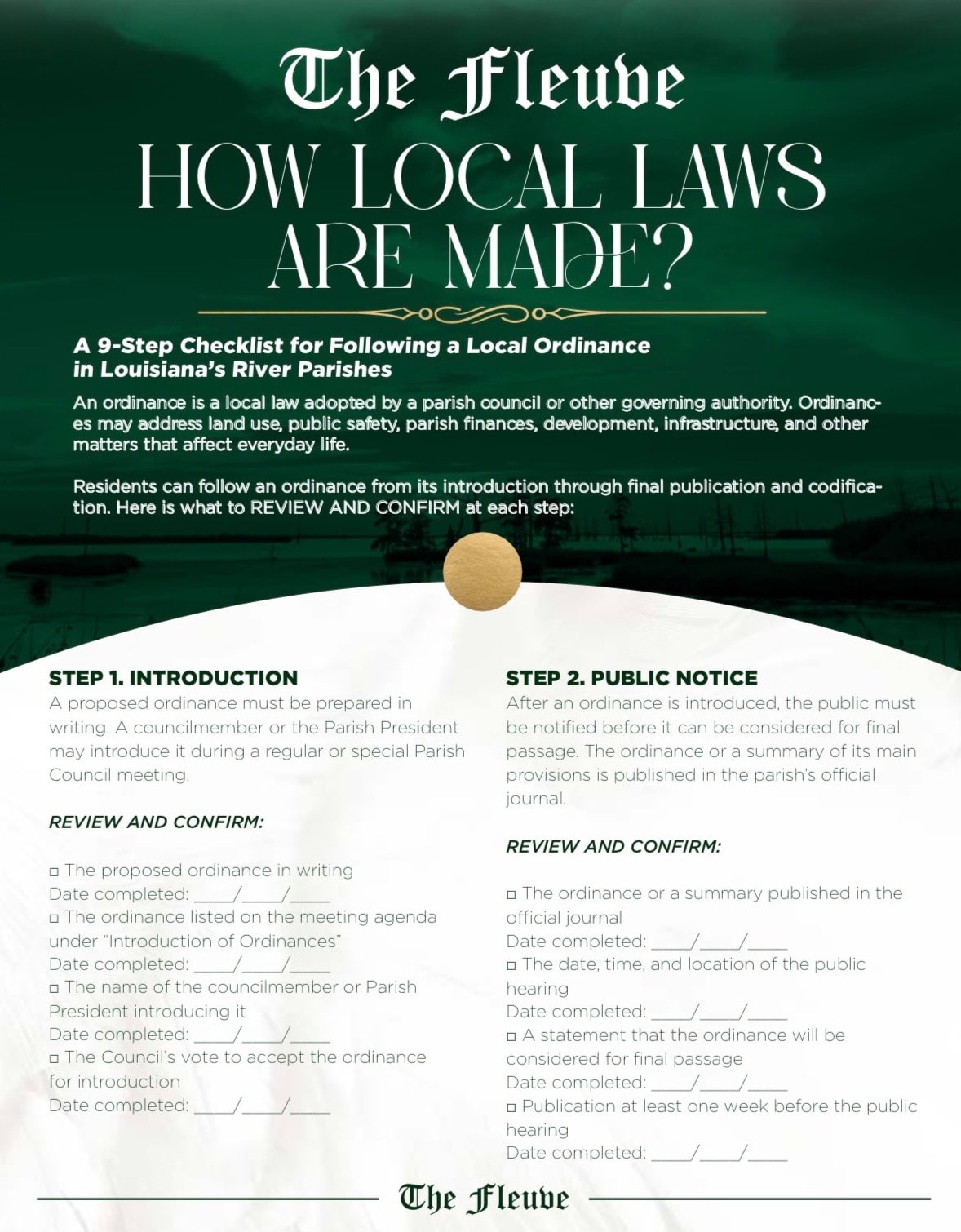
How Local Laws Are Made — A 9-Step Checklist for Following a Local Ordinance in Louisiana's River Parishes
Policy·

A 9-Step Checklist for Following a Local Ordinance in Louisiana’s River Parishes

The Fleuve Introduces Civic Toolkit Item No. 1

Hahnville, LA

Local government procedures protect the democratic process through supporting fairness, transparency, and accountability in public decision-making. They are not simply technical standards but public protections. When these procedures are not followed, the people who lose the most are often those with the least access to power, including low-income residents, older adults, rural communities, people without legal representation, and communities already carrying environmental or economic burdens.

We're pleased to introduce Item No. 1 in our Civic Toolkit, a collection of practical materials created to promote an informed citizenry.

"A 9-Step Checklist for Following a Local Ordinance in Louisiana's River Parishes" explains how a local ordinance moves through the lawmaking process. The checklist covers nine stages, beginning with the introduction of a proposed ordinance and continuing through public notice, a public hearing, adoption, signatures, executive approval, publication, recordkeeping, and codification.

An ordinance is a law established by a governmental authority, specifically a regulation adopted by a local government.1 It may address land use, public safety, parish finances, development, infrastructure, and other matters affecting local communities.

An ordinance differs from a resolution. Under Robert's Rules of Order, a resolution is a formal type of main motion, generally used when a proposal is important, lengthy, or suited to a written statement.2 In local government, a resolution may authorize an action, record a decision, or express the governing authority's position without becoming a local law.

According to the home rule charters reviewed in preparing this guide, the formal process for enacting an ordinance generally takes at least 14 days.3 A resolution can generally be considered and adopted at a single public meeting without following the complete ordinance-enactment process.4 Additional requirements may apply to certain resolutions under state law or other governing provisions.

Procedures may also vary for certain types of ordinances. Emergency ordinances, for example, may be introduced and adopted during the same meeting, while temporary or limited ordinances may be excluded from the Code of Ordinances.

The guide focuses on Louisiana's River Parishes and parishes governed by home rule charters. The procedures used in St. John the Baptist, St. James, and St. Charles parishes were reviewed extensively during its preparation, including the governing documents and how the ordinance process operates in practice.5

Requirements may differ depending on a parish's form of government, home rule charter, code of ordinances, and applicable state laws. The checklist therefore provides general civic information rather than parish-specific legal guidance. Residents and interested parties should review the laws and procedures governing their specific parish when following a particular ordinance.

A legally reviewed version of the guide is currently being prepared for publication. We welcome your response. Please email info@thefleuve.org with questions, comments, or feedback.

Sources & Further Reading

  1. Merriam-Webster, "Ordinance," defining an ordinance as an authoritative order or law and, specifically, a municipal regulation.
  2. Robert's Rules of Order Newly Revised, 12th ed., §10:13-16. See also the official Robert's Rules of Order website, which identifies the current edition as an authoritative guide to parliamentary procedure.
  3. See La. R.S. 33:406(B)-(D), "Enactment, Recording, and Publication of Ordinances and Resolutions," establishing separate stages for the introduction, public notice, public hearing, adoption, executive review, recording, and publication of an ordinance. The precise timeline may vary under a parish's home rule charter.
  4. See St. John the Baptist Parish Home Rule Charter, art. IV, particularly the separate procedures governing the enactment of ordinances and adoption of resolutions.
  5. See St. John the Baptist Parish Code and Home Rule Charter; St. James Parish Code and Home Rule Charter; and St. Charles Parish Code and Home Rule Charter.